







Articles, Hip, In the Press, Internal Medicine, Resources, Share Your Story, Yoga Medicine® News
It’s Not Weak, It’s Cautious: Rebuilding Nervous System Safety after Total Hip Replacement
By Mike Bunker for Yoga Medicine®.
Recovery after a total hip replacement (THR) is conventionally viewed through a biomechanical lens: restore range of motion, rebuild strength, and normalize gait. While these elements are essential, working with Diane, a 58-year-old nurse recovering from a right THR, reinforced a broader clinical truth: orthopedic rehabilitation is also shaped by protective motor strategies and perceived movement safety. Her hip wasn’t simply weak—it was operating within a cautious control strategy.
As a movement therapist who has also undergone a THR, I recognize the protective bracing, altered load sharing, and movement hesitation that can persist long after structural healing. When a joint is replaced, the hardware changes immediately. The nervous system often adapts more slowly, continuing to reference older patterns of protection. Rehabilitation becomes a process of graded exposure, load reintroduction, and rebuilding confidence under movement.
The Client Profile & Clinical Impression
When Diane began sessions one year post-surgery, she presented with a clear goal: regain strength, stability, and confidence in daily movement. Curling had been part of that picture too — she’d stepped away from the sport before her surgery due to pain, and rebuilding the confidence to return was part of what “daily movement” meant to her.
As a nurse, her work required sustained standing, lifting, and frequent directional changes. She also managed Type 2 diabetes, sleep apnea, and bilateral knee osteoarthritis, with greater involvement on the right side.
Initial Movement Pattern: Collapsed arches → knee valgus → pelvic shift → guarded gait strategy
Baseline assessment suggested a pattern consistent with protective motor control and load redistribution rather than primary hip restriction:
- Frontal plane control limitation: Trendelenburg testing showed early pelvic drop bilaterally within 3–5 seconds of single-leg stance.
- Asymmetrical posterior chain capacity: Supine single-leg bridging showed reduced endurance on the right, with early fatigue and compensatory loading through the knee.
- Sagittal plane compensation: Prone hip extension revealed lumbar extension and pelvic rotation, indicating reduced hip-spine dissociation.
Passive hip range of motion was within functional limits and non-provocative in standard testing positions (FABER and modified Ober’s), suggesting that structural mobility was not the primary limitation. Instead, movement output reflected reduced load tolerance and protective redistribution toward more familiar segments, particularly the knee.
The knee wasn’t necessarily the issue. It had become part of a compensation strategy the system relied on.
The Interventions: What Moved the Needle?
The plan of care was anchored to a meaningful functional goal: Diane’s return to her local curling club after a prolonged absence.
- Graded exposure (movement safety + tolerance building)
- Low-load capacity work (posterior chain re-engagement)
- Integrated loading (standing strength + carries)
- Task transfer (lateral movement + curling-specific patterns)
1. Graded Exposure & Interoceptive Awareness
Early sessions emphasized movement tolerance rather than performance. We used graded exposure—brief, controlled interactions with movement challenges followed by return to a baseline of comfort.
A simple internal scale was introduced: “What feels safe, uncertain, or too much?”
This helped identify early protective strategies and reduced automatic bracing.
The focus was not on pushing range or load, but on building consistency of “safe enough” movement experiences, allowing the system to recalibrate over time through repetition.
2. Posterior Chain Re-Engagement & Load Redistribution
To address knee-dominant compensation, we prioritized low-load gluteal activation strategies in supine and supported positions.
Bridge variations emphasized:
- controlled posterior pelvic tilt
- adductor co-activation
- slow eccentric lowering for control
Progressions included:
- bilateral → unilateral bias bridging
- supported standing weight shifts
- farmer’s carries for axial load tolerance
The goal was not maximal strengthening, but restoring the hip’s role in load sharing without defaulting to knee dominance.
3. Proprioception & Frontal Plane Control
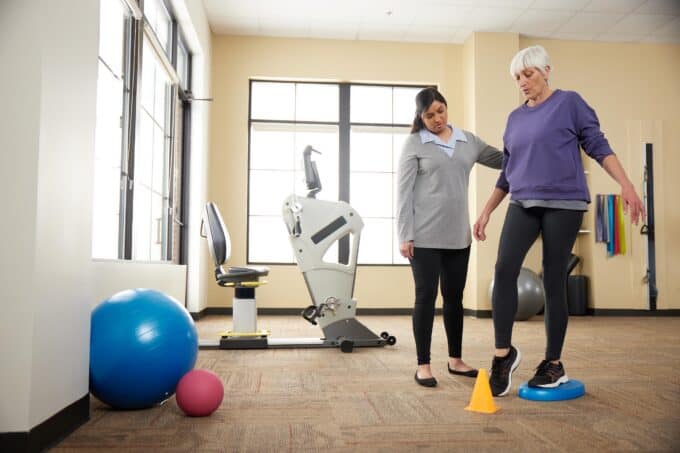
Given the demands of walking and curling, lateral stability was progressively introduced through controlled stepping and balance tasks.
This included:
- staggered stance weight shifts
- lateral stepping progressions
- controlled surface variability for sensory input
- rotational control work through the trunk
The aim was improved integration across foot–hip–trunk systems rather than instability for its own sake.
The Re-Assessment: Functional Change
After approximately eight sessions, reassessment showed meaningful improvements in control and symmetry under test conditions.
| Assessment Metric | Baseline | Follow-Up | Interpretation | ||
| Single-leg stance | Pelvic drop at 3–5 sec bilaterally | ~25 sec controlled bilaterally | Improved lateral hip endurance | ||
| Single-leg bridge | Right fatigue at 4 reps with knee compensation | 20 controlled reps bilaterally | Improved posterior chain contribution | ||
| Prone hip extension | Lumbar/pelvic compensation | Isolated hip extension control | Improved dissociation | ||
| Functional transfers | Guarded transitions | Smooth, integrated movement | Improved movement confidence | ||
Functional Outcome
A key marker of progress was Diane’s return to curling — a sport she’d left behind before her surgery once pain made it untenable. She resumed participation using a delivery stick and reported improved stability, confidence on ice, and reduced hesitation during weight shifts.
Reflective Practice
This case reinforced several refinements in my therapeutic approach:
- Earlier use of interoceptive tracking improves awareness of protective strategies.
- Simplicity early in rehabilitation likely improves motor learning efficiency.
- Distal inputs (feet and hands) play a larger role in global movement organization than often emphasized.
Conclusion
Diane’s progression highlights that post-surgical rehabilitation is not solely a process of rebuilding strength or restoring mobility, but also of re-establishing load confidence and reducing protective motor strategies.
When rehabilitation shifts from correcting movement to exploring it safely, clients often regain not only capacity, but trust in how they move.
Diane didn’t need a new body.
She needed a return to trust in the one she already had.
A Note on Current Work
I’m currently building on this work as part of my Yoga Medicine® 1000-hour certification thesis, which focuses on nervous system regulation across the full arc of hip replacement surgery — before, during, and after. As part of this research, I’m accepting 15 case study participant —people in their 50s to 70s undergoing hip replacement surgery—for an 8-session private therapeutic program that supports them through the entire process.
Spots are limited and by application; a program fee applies. Sessions can be done in person or over Zoom. I’m looking for motivated participants ready to commit to the full process. If you or someone you know fits this profile, I’d welcome a conversation.
***
About the Author

Mike Bunker is a Yoga Medicine® Registered Therapeutic Specialist, having completed his 500-hour certification, and is currently continuing his studies within the 1000-hour Yoga Medicine® program. His clinical focus includes orthopedic rehabilitation, particularly hip and knee conditions, with an emphasis on integrating therapeutic yoga into pre- and post-surgical care in collaboration with healthcare professionals. Mike offers movement therapy sessions both in-person and online.
 Login
Login